Toolbox Talk: How Loud Is Too Loud? Noise Exposure on the Job
A 5-minute toolbox talk for BC supervisors and crew leads. Read it out, or use the key points as prompts. Free to print and use.
Why this matters
Most people think of hearing damage as something that happens with one very loud bang. Usually it is the opposite: ordinary job-site noise, day after day, for years. By the time someone notices they are missing parts of conversations, the damage is done and it does not heal.
Key points to cover
- The BC limit: WorkSafeBC sets the limit at 85 dBA averaged over an 8-hour shift, and 140 dBC for any single peak, like a nail gun or a hammer on steel.
- Every 3 decibels counts: a 3 dB increase doubles the sound energy. At 85 dBA you can work about 8 hours unprotected. At 88 dBA it is about 4 hours. At 91 dBA, about 2 hours. At 100 dBA, around 15 minutes.
- Common loud jobs: grinders, chop saws, jackhammers, compressors, generators, impact tools, heavy equipment and many production lines are often well over 85 dBA.
- Distance helps: moving further from a noise source cuts the level a lot. Do not stand next to a running compressor to have a conversation.
- Off-the-job noise adds up: loud music, power tools at home, motorbikes and hunting all add to the damage. Your ears do not know whether you are on shift.
Warning signs
- Ringing or buzzing in the ears after work
- Sounds seeming muffled at the end of the day
- Having to turn the TV up, or asking people to repeat themselves
- Trouble following conversations in noisy rooms
Temporary ringing or muffling means the ears were overloaded. If it keeps happening, it turns into permanent loss.
Quick demo
Stand at arm's length from someone near running equipment and try to talk at a normal volume. If you have to shout to be understood, the noise is likely over 85 dBA and hearing protection is needed. Many free phone apps can give a rough reading as well, but they are not a substitute for a proper noise survey.
Questions to ask your crew
- Which tools or areas on this site do you think are the loudest?
- Has anyone noticed ringing in their ears after a shift?
- Where could we cut noise, by distance, enclosures or quieter equipment?
Record it
Write down the date, the topic and who attended, and keep it with your safety records.
Where Clear Work fits
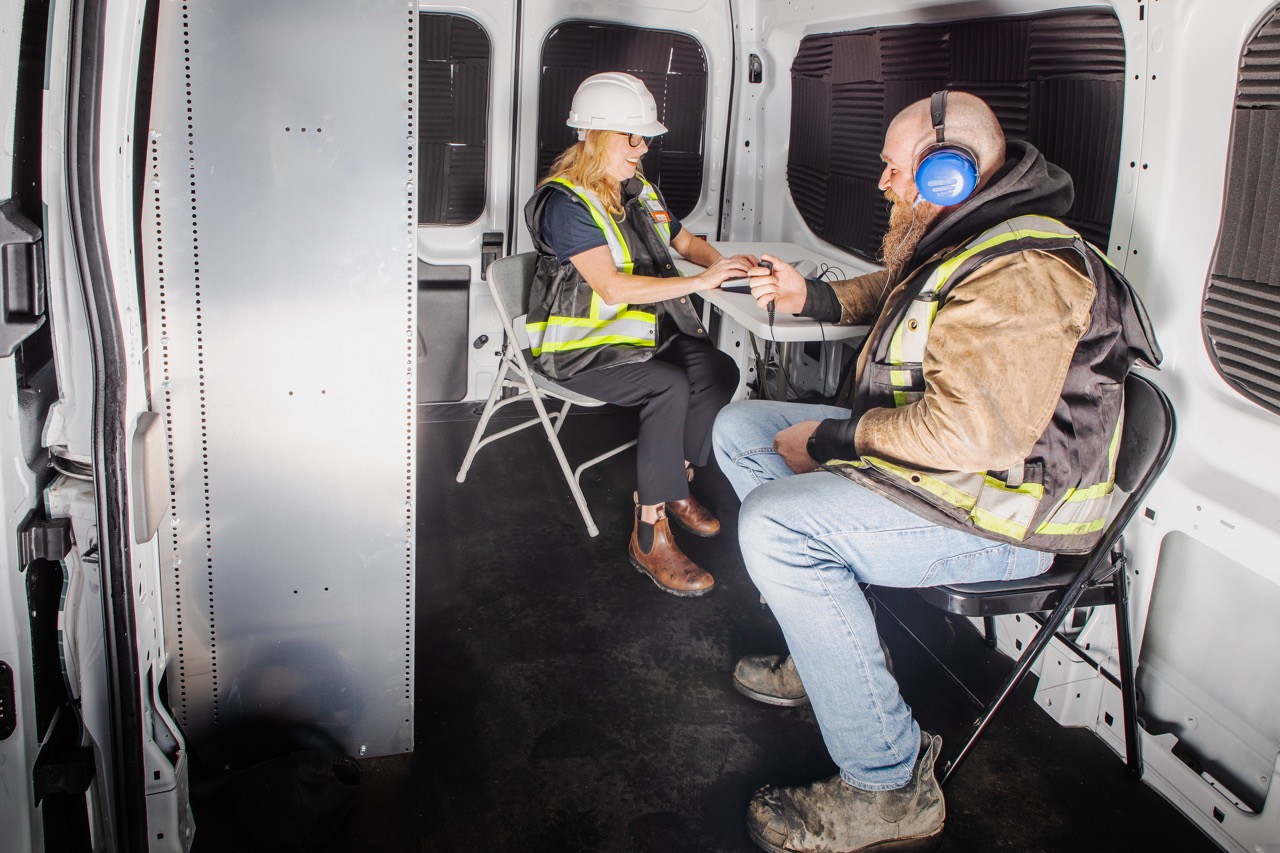
Workers exposed above the BC limits need a hearing test within 6 months of starting and every 12 months after. The annual test is how small changes get caught before they become real hearing loss. We bring mobile hearing testing to your site so nobody loses a shift.
Read more: WorkSafeBC noise exposure limits explained, or see the next talk on wearing hearing protection properly. More talks in our free toolbox talk library.
This toolbox talk is general safety information. Exposure times are approximate and assume no hearing protection. Follow your own noise survey and the current WorkSafeBC OHS Regulation.