Case Study ·
Work

20 Sawmill Workers Fitted With Custom Ear Molds in Duncan, BC

Clear Work fitted 20 workers at the Promac sawmill in Duncan, on Vancouver Island, with custom-moulded hearing protection in September 2026. Impressions were taken on site by Shruti Sahni, a licensed audiologist, and workers received Class A or Class B moulds depending on where in the mill they work.

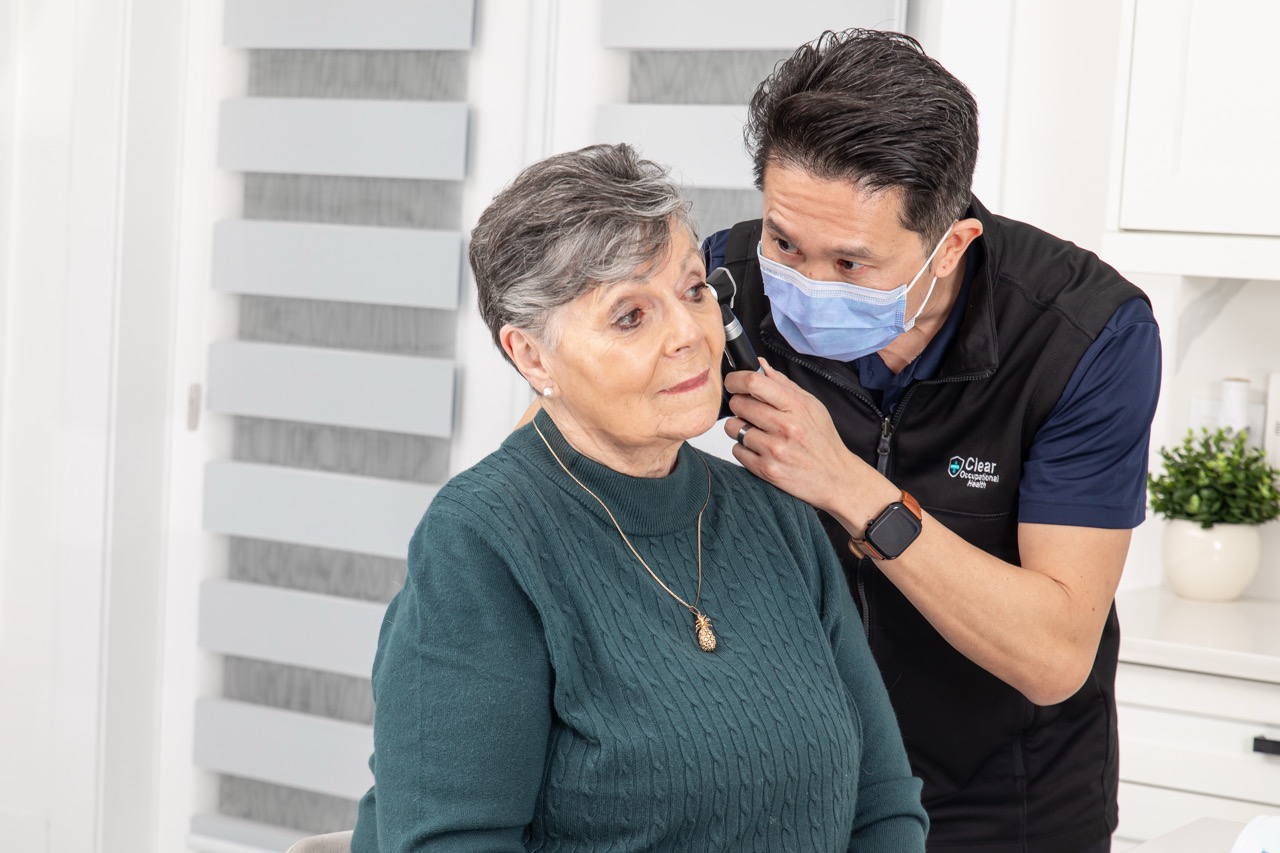
Clear Health Group clinician examining a client's ear with an otoscope
Project Snapshot
Client
Promac
Location
Duncan, British Columbia
Service Provided
On-Site Custom Ear Molds
Fitted By
Impressions taken by a licensed audiologist
Workers Fitted
20
Date
September 2026
Coverage
Vancouver Island
Protection Class
CSA Class A and Class B

About the Client

Promac is a sawmill in Duncan, in the Cowichan Valley on Vancouver Island. A mill is one of the loudest working environments in the province, and hearing protection is not optional there - it is in use for most of a shift, which makes whether it is comfortable a practical question rather than a nicety.

The Challenge
What the organization was facing

Disposable foam plugs are cheap and universally available, and that is precisely the problem with them. They are sized for an average ear canal that very few people actually have. A plug that does not seal does not attenuate, and a plug that is uncomfortable comes out the moment the supervisor turns away.

Section 7.7 of the Occupational Health and Safety Regulation is specific about this. Where noise cannot practicably be reduced to or below the exposure limits, the employer must provide hearing protection meeting CSA Standard Z94.2-02, maintain it to that standard, and ensure it is "worn effectively" in noise hazard areas.

Issuing protection is not the requirement. It has to be worn, and worn properly. In a mill, where plugs stay in for most of a shift, that is a fit problem before it is a compliance problem.

A mill is also not uniformly loud. The area around the saws is a different exposure environment from the yard or the planer, and protecting everyone to the same level either under-protects some workers or over-isolates others from the speech and alarms they need to hear.

Promac had the Vancouver Island problem on top of that: most providers are Lower Mainland based, and a crew of 20 is not getting on a ferry for ear impressions.
Our Solution

A licensed audiologist on site

Shruti Sahni travelled to the Promac sawmill in Duncan and took each impression herself. She is licensed with the College of Health and Care Professionals of BC in both Audiology and Hearing Instrument Dispensing.

That matters more than it might sound. A mail-out self-impression kit relies on the worker getting it right, and a poor impression produces a poor mould. An impression taken on site by a clinician is checked before it leaves the building.

Class A and Class B, matched to the area

Workers received either Class A or Class B moulds depending on where in the mill they work. Under the CSA classification, Class A is the higher-attenuation class, generally selected where exposure runs around 95 to 105 dBA, with Class B suited to roughly 90 to 95 dBA.

Selecting by area rather than issuing one class to everyone means the people nearest the saws get the protection that environment needs, while workers in lower-exposure areas are not cut off from speech and alarms they still have to hear.

Twenty workers, one visit

  • Each worker's ear canals individually assessed and impressed
  • Impressions sent to the manufacturing laboratory
  • Moulds made for that individual worker, not selected from a size range
  • Class A or Class B specified according to the worker's area of the mill
What was included:

The service included:

  • On-site visit to the Duncan sawmill
  • Individual ear canal assessment for each worker
  • Impressions taken by a licensed audiologist
  • Class A or Class B specified by area of the mill
  • Coordination with the manufacturing laboratory
  • Custom-moulded hearing protection for each worker
The Results
What we delivered
20 workers fitted with custom-moulded hearing protection.
Impressions taken on site by a licensed audiologist, not by a mail-out kit.
No worker travel to a clinic on the Lower Mainland.
Each set of moulds made for one individual worker's ear canals.
Class A and Class B moulds specified by area rather than one class issued to everyone.
Supports the section 7.7 requirement that hearing protection be worn effectively.

Why This Approach Worked

The reason custom moulds work is not that they attenuate better on a spec sheet. It is that workers keep them in.

A foam plug that pinches gets pulled out at the first opportunity, and a plug that is out of the ear is providing nothing at all regardless of its rated attenuation. A mould made from that specific worker's ear canal is comfortable enough to stay in for a shift, which is the only condition under which any hearing protection does its job.

Taking the impressions on site, by a clinician, removes the other common failure point - a bad self-taken impression producing a mould that never fits properly and quietly goes in a drawer.

Benefits for Similar Businesses

On-site custom ear moulds suit any employer with workers in a noise hazard area, particularly where foam plugs are not staying in.

Operations that commonly benefit include:

  • Sawmills, planer mills and wood products
  • Forestry operations
  • Manufacturing and fabrication
  • Construction
  • Municipal and public works
  • Marine and port operations
  • Warehousing and distribution
  • Agriculture and food processing

Mills in particular tend to combine ear impressions with their annual hearing testing for forestry and wood products, so the crew comes through once. Where wood dust is also a concern, spirometry can run on the same visit.

Frequently Asked Questions

Why custom moulds instead of disposable foam plugs?
arrow_forward_ios

Because foam plugs only work if they seal, and a plug sized for an average ear canal will not seal in most ears. Section 7.7 of the OHS Regulation requires hearing protection to be worn effectively in noise hazard areas - issuing it is not enough. A mould made from that worker's own ear canal is comfortable enough to stay in for a full shift, which is the only condition under which any hearing protection actually protects.

Who takes the impressions?
arrow_forward_ios

A licensed audiologist, on your site. Shruti Sahni is licensed with the College of Health and Care Professionals of BC in both Audiology and Hearing Instrument Dispensing. We do not post out self-impression kits - a poor impression produces a mould that never fits and quietly ends up in a drawer.

Do you travel to Vancouver Island?
arrow_forward_ios

Yes. This visit was to Duncan in the Cowichan Valley. We cover Vancouver Island alongside the Lower Mainland, the Fraser Valley and the Interior, and a crew of 20 is a comfortable single visit.

How do you decide between Class A and Class B?
arrow_forward_ios

By the noise in that part of the workplace. Under the CSA classification, Class A is the higher-attenuation class and is generally selected where exposure runs around 95 to 105 dBA; Class B suits roughly 90 to 95 dBA. At Promac, workers received one or the other depending on their area of the mill.

This is why noise measurement comes first. Section 7.3 of the Regulation requires an employer to measure noise exposure where workers may be exposed to potentially harmful levels, or where information suggests exposure above 82 dBA Lex. Until that is done, you are guessing at the class - and over-protecting is its own hazard when a worker needs to hear a reversing alarm.

Can this run alongside our hearing tests?
arrow_forward_ios

Yes, and most employers do it that way. Impressions can be taken during the same visit as annual audiometric testing, so the crew comes through once. It also means the people who joined since the last round get picked up rather than missed.

Can workers still hear speech and alarms?
arrow_forward_ios

That is exactly why class selection matters, and filtered moulds are available where it is a particular concern. Standard moulds attenuate broadly, which is right for some areas and wrong for others. Where workers need to hear each other or need to hear a reversing alarm, we will advise on the appropriate class and on filtered options.

The Clear Health Difference
Why employers across BC choose us
Impressions taken on site by a licensed audiologist
Moulds made for one individual worker
Filtered options for workers who need to hear speech and alarms
Fitted alongside annual hearing tests in the same visit
Vancouver Island and Lower Mainland coverage
Province-wide mobile service
Responsive customer support
Fast, efficient booking and administration

Bring occupational health testing to your workplace

Custom Ear Molds Fitted at Your Mill

Whether you need 20 workers fitted or 200, we bring a licensed audiologist to your site and take the impressions there.

Custom-moulded hearing protection made for each individual worker, with the protection class matched to the noise in their area rather than issued in one size. Vancouver Island, the Lower Mainland, the Fraser Valley and the Interior.

Contact Clear Work to book custom ear moulds for your crew.